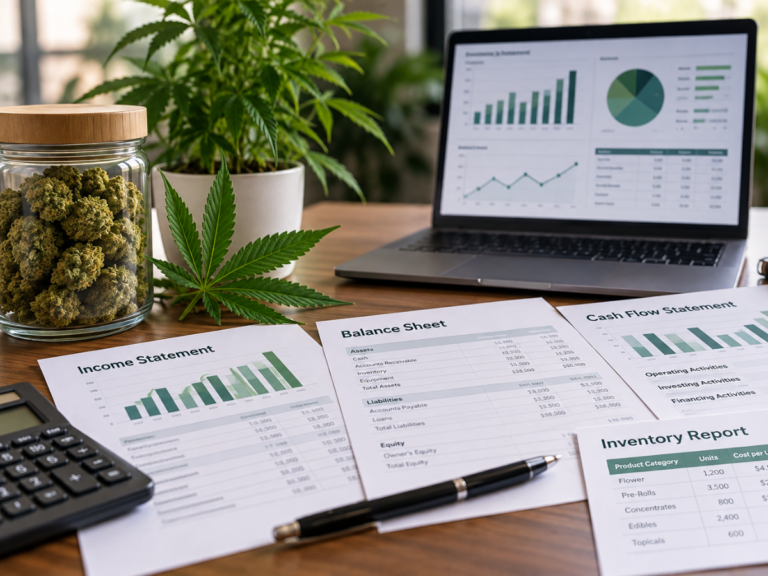
Running a cannabis business involves more than tracking sales and expenses. Operators need to understand where revenue is coming from, how much the business is spending, whether margins are changing, and how much cash is available to support ongoing operations.
Financial reports bring these details together in a format that can help owners and management evaluate business performance. Reviewing the right reports regularly can make it easier to identify changes, compare results over time, and make informed financial decisions.
For cannabis businesses, accurate financial reporting can be especially useful because operations may involve inventory, multiple revenue streams, significant operating costs, and other financial considerations that require close attention. Working with a cannabis CPA can help ensure financial information is organized, reviewed, and presented in a way that supports better business decisions. GreenGrowth CPAs provides accounting and financial support for businesses that need reliable financial information to guide their operations and planning.
Why Financial Reports Matter for Cannabis Businesses
Financial reports provide a clearer view of what is happening inside a business than sales figures alone.
A cannabis business may generate strong revenue while still experiencing pressure from rising operating costs, inventory expenses, payroll, or other financial obligations. Looking at several financial measures together can help management understand whether the business is actually performing as expected.
Regular financial reporting can help operators:
- Monitor revenue and expenses
- Evaluate profitability
- Track cash availability
- Identify changes in operating costs
- Review inventory-related financial information
- Compare current performance with previous periods
- Support budgeting and forecasting
- Make better-informed business decisions
The value of these reports depends on the quality of the underlying financial information. Accurate records and consistent reporting provide a stronger basis for evaluating business performance.
Income Statement
The income statement is one of the most important financial reports for reviewing business performance. It shows revenue, expenses, and the resulting profit or loss over a specific period.
For a cannabis business, reviewing the income statement can help management understand how much revenue the company generated and how much it spent to operate.
Important figures may include:
- Sales revenue
- Cost of goods sold
- Gross profit
- Operating expenses
- Payroll expenses
- Rent and occupancy costs
- Marketing expenses
- Professional fees
- Net income or loss
Looking at these figures together can reveal changes that may not be obvious from revenue alone.
For example, sales may increase from one period to the next while operating expenses increase even faster. In that situation, higher revenue does not necessarily mean the business is becoming more profitable.
A cannabis CPA can help management review these results and identify the financial trends that deserve closer attention.
Balance Sheet
The balance sheet provides a snapshot of a company’s financial position at a specific point in time.
It generally presents three major categories:
- Assets
- Liabilities
- Equity
Assets may include cash, accounts receivable, inventory, equipment, and other resources owned or controlled by the business. Liabilities can include accounts payable, loans, and other financial obligations.
Reviewing the balance sheet can help cannabis operators understand what the business owns, what it owes, and how its financial position is changing.
For example, a business may have increased its inventory significantly while cash has declined. Looking at the balance sheet alongside other financial reports can help management understand how resources are being allocated and whether additional planning may be needed.
The balance sheet is also useful when evaluating the company’s overall financial position before making major spending, financing, or expansion decisions.
Cash Flow Statement
Profitability and cash availability are not the same thing.
A business can report a profit while still experiencing periods of limited cash. The cash flow statement helps explain how cash moves into and out of the business during a specific period.
Cash flow is generally reviewed across three areas:
- Operating activities
- Investing activities
- Financing activities
For cannabis operators, reviewing cash flow can help show whether day-to-day operations are generating enough cash to support ongoing expenses and other financial commitments.
Management can also use cash flow information when considering purchases, investments, debt payments, or other uses of available funds.
Regular cash flow reviews can make it easier to identify periods when cash may become tighter and allow management to plan before those pressures become more difficult to manage.
Inventory Reports
Inventory can represent a significant financial investment for many cannabis businesses.
Operators need to understand not only how much inventory they have but also how inventory affects costs, sales, and profitability.
Inventory reporting can help management review:
- Inventory quantities
- Inventory costs
- Cost of goods sold
- Inventory turnover
- Changes in inventory value
- Slow-moving inventory
- Product-level performance
Reviewing inventory alongside sales and cost information can provide a more complete picture of business performance.
For example, a business may have a large amount of inventory on hand but relatively slow sales for certain products. That situation may affect cash availability and indicate that management should examine purchasing, pricing, or product-level performance more closely.
Accurate inventory records also contribute to more reliable financial reporting.
Accounts Receivable and Accounts Payable
Accounts receivable and accounts payable can provide useful information about the timing of money coming into and leaving the business.
Accounts receivable represents amounts owed to the business, while accounts payable represents amounts the business owes to vendors and other parties.
Reviewing these balances can help management identify:
- Outstanding customer balances
- Delayed payments
- Upcoming vendor obligations
- Changes in payment patterns
- Potential cash flow pressures
These reports become more useful when reviewed over time rather than only when a payment problem occurs.
For businesses that work with multiple vendors or customers, keeping track of outstanding balances can also help management understand how much cash is committed and when funds may become available.
Gross Margin and Profitability Reports
Revenue tells management how much the business sold. Profitability reports help explain how much the business actually retained after relevant costs.
Gross margin is particularly useful because it compares revenue with the costs directly associated with generating that revenue.
Management can review gross margins across different products, categories, locations, or periods to identify changes in profitability.
For example, two products may generate similar sales but have different costs. The product with the higher sales figure is not necessarily the one contributing the most gross profit.
Breaking financial results down into meaningful categories can help operators identify which areas of the business are performing well and which may require closer review.

Budget vs. Actual Reports
Comparing planned financial results with actual results can help management determine whether the business is operating according to its expectations.
A budget vs. actual report may compare expected and actual figures for:
- Revenue
- Payroll
- Inventory purchases
- Rent
- Marketing
- Operating expenses
- Capital expenditures
Significant differences can provide an opportunity to investigate what changed and why.
For example, if operating expenses are consistently higher than budgeted, management can review the underlying costs and determine whether the difference is temporary or part of a broader trend.
This type of reporting can also improve future budgeting by showing where previous estimates were accurate and where adjustments may be needed.
Financial Reports to Review Together
Individual reports provide useful information, but reviewing them together can give management a more complete view of the business.
For example, the income statement may show increasing revenue, while the cash flow statement shows declining operating cash. The balance sheet may then reveal that more money is tied up in inventory or receivables.
Looking at these reports together can help explain why strong sales may not always translate into stronger cash availability.
A regular financial review can connect information from:
- Income statements
- Balance sheets
- Cash flow statements
- Inventory reports
- Accounts receivable reports
- Accounts payable reports
- Profitability reports
- Budget vs. actual reports
This broader view gives management more context when evaluating business performance.
Need a clearer view of your financial performance? Schedule a consultation to discuss your financial reporting, accounting processes, and the information you need to better understand your cannabis business.
How Financial Reports Can Reveal the Bigger Picture
Consider a cannabis business generating $300,000 in monthly revenue. At first glance, that may appear to indicate strong performance. However, if total costs and expenses reach $270,000, the business has $30,000 remaining before other financial considerations.
Reviewing the income statement alone may not explain why cash remains tight. Management could also review the balance sheet and cash flow statement to determine whether cash is tied up in inventory, receivables, or other areas. This type of review can give owners a clearer understanding of what is driving their financial results.
How Cannabis Accounting Services Support Financial Reporting
Preparing financial reports requires more than putting numbers into a spreadsheet. The underlying records need to be accurate, consistent, and organized so that the resulting reports provide useful information.
Cannabis accounting services can support businesses with financial recordkeeping, reporting, account reconciliation, and other accounting functions that contribute to reliable financial information.
Professional accounting support can also help management establish consistent reporting practices and identify financial information that should receive closer attention.
The specific support a business needs can vary based on its size, operations, accounting systems, and financial complexity. The goal is to make financial information easier to understand and use when reviewing business performance.
How Often Should Cannabis Businesses Review Financial Reports?
The appropriate review schedule depends on the business and the financial information being reviewed.
Some financial information may be reviewed weekly, particularly when management needs close visibility into cash, sales, inventory, or outstanding balances. Other reports may be reviewed monthly or quarterly as part of a broader financial review.
The important factor is consistency.
Regular reporting makes it easier to compare results across periods and identify changes while there is still time to respond. Waiting until the end of the year to review financial performance can make it harder to understand when a problem began or what caused it.
A consistent reporting process can give management a clearer view of financial performance throughout the year.
Ready to make more informed financial decisions? Talk with a cannabis accounting specialist about your reporting needs, cash flow, profitability, and the financial information you use to plan your next steps.
Questions to Ask When Reviewing Financial Reports
Simply receiving financial statements does not mean the information is being used effectively.
Operators can ask questions such as:
- Are revenues increasing or decreasing?
- Which products or business activities are generating the strongest margins?
- Are operating expenses changing significantly?
- Is cash flow keeping pace with business needs?
- Is too much cash tied up in inventory or receivables?
- Are actual expenses consistently exceeding the budget?
- Are there financial trends that require further investigation?
These questions can turn financial reports from passive records into tools for ongoing business analysis.
Use Financial Reporting to Support Better Decisions
Financial reports are most valuable when they help management understand what is happening and decide what to do next.
An operator considering a new location may need to review cash flow and projected expenses. A business evaluating product performance may need to compare revenue, inventory costs, and margins. Management considering additional hiring may need to understand current payroll costs and available cash.
The reports do not replace management judgment. Instead, they provide financial information that can help management evaluate different options.
A cannabis CPA can provide additional context when financial results are difficult to interpret or when a business needs a more detailed review of its financial position.
Frequently Asked Questions
What financial reports should a cannabis business review regularly?
A cannabis business should regularly review its income statement, balance sheet, cash flow statement, inventory reports, accounts receivable and payable, profitability reports, and budget vs. actual reports. Reviewing these reports together gives owners and management a clearer view of revenue, expenses, cash flow, inventory, profitability, and overall financial performance.
How often should cannabis businesses review financial reports?
Cannabis businesses should review financial reports at least monthly, although some financial information may need more frequent attention. Sales, cash flow, inventory, and outstanding balances may be monitored weekly, while broader financial statements can be reviewed monthly or quarterly. Consistent reviews make it easier to identify changes and address issues promptly.
Why is inventory reporting important for cannabis businesses?
Inventory reporting is important because inventory can affect costs, cash flow, profitability, and financial reporting. Reviewing inventory quantities, costs, turnover, and product-level performance can help business owners identify slow-moving products, understand how much capital is tied up in inventory, and evaluate whether purchasing levels align with sales.
What does a cannabis CPA do with financial reports?
A cannabis CPA can help business owners organize financial information, review financial reports, identify important trends, and provide context for financial results. Professional support can also help businesses maintain consistent accounting processes and use financial information when evaluating expenses, cash flow, profitability, inventory, and other business decisions.
Can financial reports help cannabis businesses make better decisions?
Yes, financial reports can help cannabis businesses make better decisions by providing current information about revenue, expenses, cash flow, inventory, profitability, and financial position. Owners can use these reports when evaluating spending, inventory purchases, staffing, expansion plans, and other business decisions that depend on a clear understanding of the company’s finances.
Keep Your Finances on Track
Financial reports give cannabis operators a clearer view of business performance and financial position. Income statements, balance sheets, cash flow statements, inventory reports, receivables and payables reports, profitability reports, and budget comparisons each provide different pieces of the overall picture.
Reviewing these reports consistently can help management identify changes in revenue, costs, margins, cash flow, and other important financial measures. It can also provide better information when evaluating investments, spending decisions, and future business plans.
Professional cannabis CPA services can help businesses maintain reliable financial records and turn those records into useful financial information. With the right reporting process in place, operators can better understand their numbers and make decisions based on a clearer view of the business.
Reliable financial reporting can provide the information businesses need for ongoing management and decision-making. Contact GreenGrowth CPAs to discuss your business’s accounting and financial reporting needs.
Get more GreenGrowth CPAs insights in Google Search and AI Mode.